The AI Disruption and New SEO Disciplines

Share this post
User behavior shifted, with millions of users beginning to use ChatGPT, Claude, and Perplexity for research, comparison, and general knowledge tasks they previously used Google for.
How AI Broke Traditional SEO
- The launch of ChatGPT in November, 2022 did not just change consumer behavior; it sent shockwaves through the entire SEO industry. For the first time, users had an alternative to Google that could provide direct, conversational answers to complex questions.
- User behavior shifted, with millions of users beginning to use ChatGPT, Claude, and Perplexity for research, comparison, and general knowledge tasks they previously used Google for.
- The search results page itself changed as Google responded by launching AI Overviews, embedding AI-generated summaries at the very top of results. Traditional organic links were pushed further down the page for many query types.
- The opportunity lies in the fact that most businesses and most SEO agencies have not adapted yet. The gap between those who understand AI-era SEO and those who are still doing SEO the old way is widening every month. Early movers will dominate their industries in AI search visibility for years to come.
Google AI Overviews and AI Mode: The New Face of Search

Google AI Overview
Google's AI Overviews represent the most significant change to Google's search results page in its history. When a user searches for an informational query, Google's AI generates a summary answer at the top of the page, drawing from multiple sources. The individual sources are cited in small links within or beside the summary.
According to Google's own published data, AI Overviews currently appear in approximately 47 percent of all Google searches. Google has also launched AI Mode, a fully conversational search experience that allows users to ask multi-part follow-up questions.
For SEO, this means that pages cited in AI Overviews receive a new type of visibility even when the user does not click through. Optimizing for AI Overviews requires structured, authoritative, clearly written content that an AI can easily extract and cite. Websites with strong E-E-A-T signals are consistently more likely to be cited as sources.
ChatGPT Search, Perplexity and Gemini: The Platforms Competing with Google
For the first time in two decades, Google's dominance in search is being genuinely challenged by multiple AI platforms.
ChatGPT Search has integrated web search directly into ChatGPT, allowing it to provide real-time answers with citations. With hundreds of millions of active users globally, ChatGPT has become a primary research tool for a growing portion of internet users. Perplexity AI has emerged as the most direct competitor to traditional search, offering clean, cited answers with source links and processing tens of millions of queries daily.
For SEO professionals and businesses, this new way of search means one critical thing: you can no longer optimize for one platform. Your content needs to be discoverable, citable, and authoritative across multiple AI and search platforms simultaneously.
Is Traditional SEO Becoming Obsolete?
The short answer is no.
Traditional SEO remains the foundation of online visibility. Websites still need technical optimization, content quality, authority signals, and positive user experiences. Without these fundamentals, neither search engines nor AI systems can effectively evaluate a business.
Previously, success was measured primarily through rankings and traffic. Today, visibility can also come from AI-generated answers, citations, recommendations, and brand mentions across digital ecosystems. Traditional SEO is not disappearing. It is becoming one component of a broader visibility strategy that includes AI Search Optimization, Entity SEO, Topical Authority Development, and Generative Engine Optimization.
How AI Systems Discover, Understand, and Recommend Brands
AI systems do not think like humans. They identify patterns across vast amounts of information and evaluate which sources appear most trustworthy and relevant. Several factors influence whether a brand is mentioned in AI-generated responses.
- Website quality and technical health
- Content depth and topical comprehensiveness
- Brand mentions across reputable third-party websites
- Structured data implementation and schema markup
- Topical authority across the brand's domain
- E-E-A-T Signals
- Entity recognition: whether the brand exists as a clearly defined entity in knowledge graphs
When a brand consistently appears in trusted industry sources and publishes comprehensive content around a topic, AI systems become more likely to recognize and reference that brand. This is why businesses must invest beyond simple keyword optimization and focus on building digital authority across multiple channels.
What are the new SEO Disciplines?
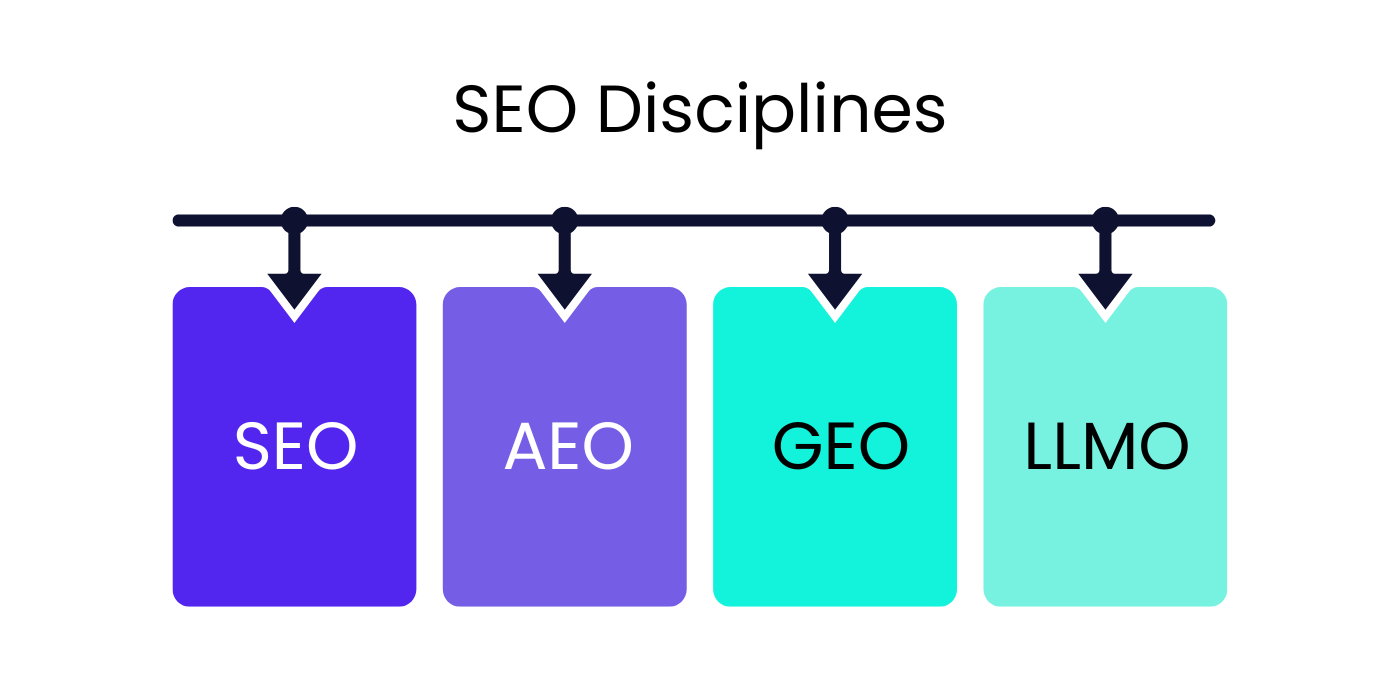
SEO Disciplines
From Keywords to Entities
Search engines have evolved far beyond simple keyword matching. Early SEO strategies focused heavily on identifying keywords and placing them throughout a page. Modern search engines and AI systems now attempt to understand concepts, relationships, and context.
This evolution has led to the rise of Entity SEO. An entity is a uniquely identifiable person, company, product, location, concept, or organization that search engines can recognize independently of keywords. For businesses, this means SEO is no longer just about ranking pages. It is about ensuring search engines and AI systems understand who you are, what you do, and how you relate to your industry. Companies that successfully establish strong digital entities are more likely to appear in search results, AI recommendations, knowledge panels, and industry-related discussions.
Semantic SEO and the Move Beyond Exact-Match Keywords
Semantic SEO focuses on meaning rather than individual keywords. A search engine understands that software modernization services, legacy system modernization, and application modernization are closely related concepts. Modern algorithms can connect these ideas and determine whether a piece of content comprehensively addresses a topic.
Businesses should focus on creating topic-rich content that answers multiple related questions rather than producing separate pages for every keyword variation. This improves user experience while helping search engines understand the depth of expertise behind the content. Semantic SEO also aligns closely with how AI models process information. Large Language Models evaluate context, relationships, and topical coverage rather than relying solely on exact keyword matches.
Topical Authority: The New Competitive Advantage
Topical Authority has become one of the most important concepts in modern SEO. Instead of publishing isolated articles, successful businesses build comprehensive ecosystems of content around specific subjects. The goal is to demonstrate deep expertise within a particular industry or niche.
For example, a company offering digital marketing services should not only publish pages about digital marketing broadly. It should also create content covering SEO, paid advertising, content strategy, social media, email marketing, conversion optimization, analytics, and related topics in depth. When search engines and AI systems consistently see high-quality content across an entire topic area, they begin to recognize the brand as an authority.
Topical authority is especially important because AI systems favor sources that demonstrate broad expertise rather than websites that only target isolated keywords. Building topical authority requires mapping all subtopics within a domain, creating a content cluster structure with pillar pages supported by detailed supporting articles, and consistently covering new developments in the subject area.
Understanding Generative Engine Optimization (GEO)
Generative Engine Optimization (GEO) is an emerging discipline focused on increasing visibility within AI-generated responses. Traditional SEO primarily aims to improve rankings in search engine results pages. GEO focuses on helping brands become sources that AI systems reference, cite, and recommend.
When a user asks an AI assistant about the best digital marketing agencies, the AI generates a response based on trusted sources it has identified across the web. Businesses that have established strong authority and credibility have a greater chance of being included in those recommendations.
Key GEO strategies include building entity authority by ensuring consistent brand information across all online platforms, publishing original research and data that AI systems can cite, earning mentions on authoritative third-party publications, structuring content with clear headings and factual statements that AI systems can easily retrieve, and monitoring brand presence across AI platforms using tools like Ahrefs Brand Radar.
Answer Engine Optimization (AEO): Ranking Inside AI-Generated Answers
Answer Engine Optimization (AEO) is the practice of optimizing content specifically to appear in AI-generated answers, featured snippets, voice search results, and conversational AI responses. The core principle is simple: if you want AI systems to use your content as a source, your content must be structured to be easily extracted and cited.
Key AEO strategies include formatting content to start each section with a clear, concise answer before elaborating, structuring content explicitly as questions and answers to mirror how AI systems retrieve information, using FAQ schema and Article schema markup to help machines understand content structure, writing in the same natural language that users speak, and citing credible external sources within content to signal trustworthiness.
LLM SEO: Optimizing for AI-Powered Search
Large Language Models (LLMs) are transforming how users find information. Unlike traditional search engines that return a list of links, LLMs generate direct answers based on information they can access and evaluate. LLM SEO focuses on improving a brand's visibility within these AI-driven environments.
This involves creating content that is well-structured, factually accurate, easily understandable, rich in contextual information, and supported by authoritative external references. The objective is to help AI systems recognize a business as a reliable source within its industry. Brands that establish strong authority across multiple channels have a greater chance of appearing in AI-generated recommendations, summaries, and citations across ChatGPT, Perplexity, Gemini, and Google AI Overviews.
Voice Search Optimization: Ranking for How People Speak
Voice search has fundamentally changed how queries are phrased. When typing, people use shorthand. When speaking, they use complete, natural sentences.
Voice search optimization requires targeting conversational long-tail keywords that mirror natural speech patterns, optimizing for local intent since a large portion of voice searches include near me qualifiers, and winning the featured snippet since voice assistants most frequently read out the featured snippet for a given query. Page speed is also critical; voice search results heavily favor fast-loading pages.